Author Archives: Harry Styron

Federally-managed Ozarks rivers require protection, even abstinence


How and how much protection to give the Jacks Fork, the Current and the Buffalo rivers is much on the minds of people in and around the Ozarks this summer. Those of us whose memories of these treasures span several decades are sad about the effects of overuse and unwise use.

As the National Park Service (NPS) gathers public comments in formal planning meetings and in writing, those united in loving these rivers have diverse and sometimes incompatible desires for how these rivers and the land along them will be managed. With long stretches of these rivers owned by the federal government and managed by the NPS (which also manages easements along the rivers and regulates outfitters), it’s appropriate that the NPS find out how citizens want these shared resources to be managed.

As individuals, we each have our own ideas about our relationship with the natural world and different comfort levels with sharing, and these ideas change somewhat over time, in response to our experiences, our scientific knowledge, our age-appropriate preferences in recreation, and even our financial situations.

Those who formulate policies have to formulate policies that will probably not make any of the various stakeholder groups happy, but will assure that the members of these groups will keep on using the resources so that federal funding will be maintained.

Ozark National Scenic Riverways General Management Plan

For the Jacks Fork and Current rivers, which are in the Ozark National Scenic Riverways, the NPS has prepared a document called “Preliminary Alternatives” which helpfully sets out four alternatives for the management of these rivers and a zoning system that would protect ecological systems and human experiences by limiting uses (for example, limiting horse access to designated trials and fords and limiting the size of boat motors in particular stretches of the rivers during specified seasons).

I urge you to study the Preliminary Alternatives document carefully before commenting. You can read a summary and the entire Preliminary Alternatives document and make your comment by going to this page.

For the Ozark National Scenic Riverways General Management Plan, the official public comment period remains open until July 31, 2009, and some time after that the NPS will select one of the alternatives, or some combination of them.

Buffalo National River General Management Plan

For the Buffalo River in Arkansas, which is managed by the National Park Service as the Buffalo National River, the planning process is in the early stages. This summer, the NPS has been holding public meetings to gather comments before preparing a document that will probably resemble the Ozark National Scenic Riverways’ Preliminary Alternatives.

For this stage in the planning process, the comment period closes August 31, 2009. The newsletter describing the planning process, including a schedule, can be found here.

__________________________________________

On the Fourth of July, I went floating on a river that is within 50 miles of the largest city in the Ozarks. The river was nice. I saw only two canoes other than the ones in my group. Had we been on a federally-managed river, there would have been a crowd.

With respect to the Jacks Fork, the Current, the Eleven Point, and the Buffalo, the best policy–and the least expensive–might be abstinence or at least restraint.  Instead of floating four times per year, go twice. Send your outfitter the money that you would have spent.

Water + animosity = punitive damages

Posted on

Bad fences make bad neighbors, especially if the neighbors start retaliating. Then it escalates.  They lawyer-up and make things even worse.

Greg and Lisa lived next to Tim on large tracts in a suburbanizing area southeast of Kansas City. They talked about building a fence on their common boundary, where a ditch looped from Greg’s and Lisa’s property onto Tim’s for 50 feet, then came back to Greg’s and Lisa’s property.

Tim put up “no trespassing” signs after seeing Greg and his son walking along the property line. “Somebody” shot the sign with a shotgun Read the rest of this entry

What does Honduras have to do with the Ozarks?


Ozarkers think of themselves as the real people, the salt of the earth, practical, not putting on airs, skeptical but tolerant, willing to help those in need. Our first impulse in meeting someone new is to figure out whether that person is from around here. My guess is that these characteristics are a universal part of human nature in which the question “friend or foe?” is the first issue at the first encounter.

If our first impulse is to stand our own ground, why should we be interested or concerned about what happens in one of the many countries of Central America, especially one as poor as Honduras, whose military just removed the president and sent him into exile in Costa Rica?

Honduras has been an independent republic for as long as Missouri has been a state (since 1821). Honduras is about the size of Tennessee, with a long northern coastline on the Caribbean and a small Pacific coast on the Gulf of Fonseca in the south. The population of Honduras is just under 8 million (like Missouri, Iowa and Arkansas combined), with a per capita annual income of about $4,400 (compared to around $20,000 in the Ozarks).

I don’t have a good feel for Honduran politics, so I’ll let Max Carranza  tell his version (shortened by me) of recent events: Read the rest of this entry

Missouri PSC asserts jurisdiction over one tiny utility company, but many others escape


Water and sewer services to residences and businesses are essential. Most of us take for granted that the operations of those who provide these services are reliable and are regulated. In reality, many water and sewer providers fall through several holes in Missouri’s statutory framework of regulation by the Missouri Department of Natural Resources (DNR) and the Missouri Public Service Commission (PSC).

DNR’s regulations

DNR sets engineering standards for water wells, treatment and storage facilities, and distribution systems (mains and valves). DNR licenses well drillers and maintains a registry describing each water well, based on data required to be submitted by well drillers. DNR does not regulate rates charged by water sellers, but does require that permanent entity (called a “continuing authority”) be established for each water system serving more than 15 users. A continuing authority for water is required to show DNR that it has the technical, managerial and financial capacity to operate the system, or at least that’s what the rules say. DNR implements its regulations by requiring submittal of engineering plans for the issuance of construction permits and certfications from private engineers that water and sewer facilities are completed according to the approved plans before issuance of operating and discharge permits. DNR also licenses operators of water and sewer facilities. Read the rest of this entry

Fathers of my understanding of the Ozarks


Someone looking at my life could correctly observe that my life’s work has consisted of absorbing all I can about the history, economy and people of the Ozarks. I began this undertaking as a youngster at the Newton County Library in Neosho in about 1960, probably with a book by Vance Randolph or the Chapmans’ Indians and Archaeology of Missouri.

Much of what I have learned about life in the Ozarks has come from living and working in the Ozarks. But what I’ve learned from books and scholars has given me a mental framework for organizing what I have learned and helps me to be a better observer. Read the rest of this entry

Table Rock Lake and the cost of economic activity

Posted on

Kathleen O’Dell’s article about the economic impact of Table Rock Lake in today’s Springfield News-Leader, entitled “Table Rock Dam Gives Much Back to Area,” covers a lot of ground in describing the various kinds of economic activities that are related to the construction and continued existence of Table Rock Lake.

In an economic sense, is the Table Rock Lake area fit (efficient and nimble) or obese (expensive to maintain and subject to falls)? As pointed out below, the two counties most affected by Table Rock Lake have experienced the area’s lowest growth in Read the rest of this entry

The case of the disappearing plaintiff

Posted on

Why would a plaintiff (the party who files a suit) fail to show up for trial? How long should a court keep the suit alive, if the plaintiff doesn’t seem to care?

In a recent opinion, Springfield’s Southern District of the Missouri Court of Appeals affirmed the trial judge’s determination that it a plaintiff who failed to show up for trial could not have another chance to assert its rights three years later. The losers here, named Kissee, filed a suit against E-Z Pawn for the recovery of jewelry left there for cleaning.

When the Kissees failed to show up for the trial, the trial judge merely noted in the court records that they failed to show. Nearly a year later, the pawnshop’s attorney sent a cash settlement offer to the Kissees, but apparently that letter did not lead to a settlement.

Six months later, Read the rest of this entry

Decorating and undecorating graves

Posted on

Objects on a tombstone

The weather was rainy in much of the Ozarks today, so I was glad that I had visited cemeteries of mine and my wife’s ancestors on Friday and Sunday.

Pam’s comment to my previous post mentioned the custom of leaving small stones on a tombstone to indicate that a visit was made. I have not seen this, but I saw the arrangement above on a tombstone at Snowdenville Cemetery in eastern Madison County, Missouri, which could have been the work of a groundskeeper who picked up things ahead of the mowers, or it could have been a loving tribute.

When I was sixteen or seventeen, I was hired to mow the Newtonia IOOF Cemetery in Newton County, Missouri. Removing the artificial flowers and the containers of real and artificial flowers, with lots of wire and accessories, was a tedious job, especially for a self-important teenager. In preparing the cemetery for Memorial Day, my mower frequently hit those items as I plowed through the thick spring grass, leaving me to pick up the shredded plaster and plastic pots and unwind the wires from my mower blade.

Many of those paid and unpaid people who maintain cemeteries would be able to do their work more safely and easily if those who leave items would make another visit to pick up those items. These items are decorative for only a few days.

Take a trip to the past on Memorial Day

Posted on

Forsyth Cemetery

Forsyth Cemetery

Cemeteries, for me, offer a place of quiet contemplation. Sometimes, I know just enough of the people buried there to set my imagination running about lives, times and places.

This cemetery in Forsyth holds the remains of Nathaniel Kinney, who led a vigilante group, the Bald Knobbers, for five years before losing his life to vengeance. It also holds the remains of John Hilsabeck, who operated a hotel on the White River at the mouth of Swan Creek in the old Forsyth townsite. At this cemetery, in 1892, John Wesley Bright was hung after having been pulled out of the Taney County jail where he was held for the killing of his young wife.

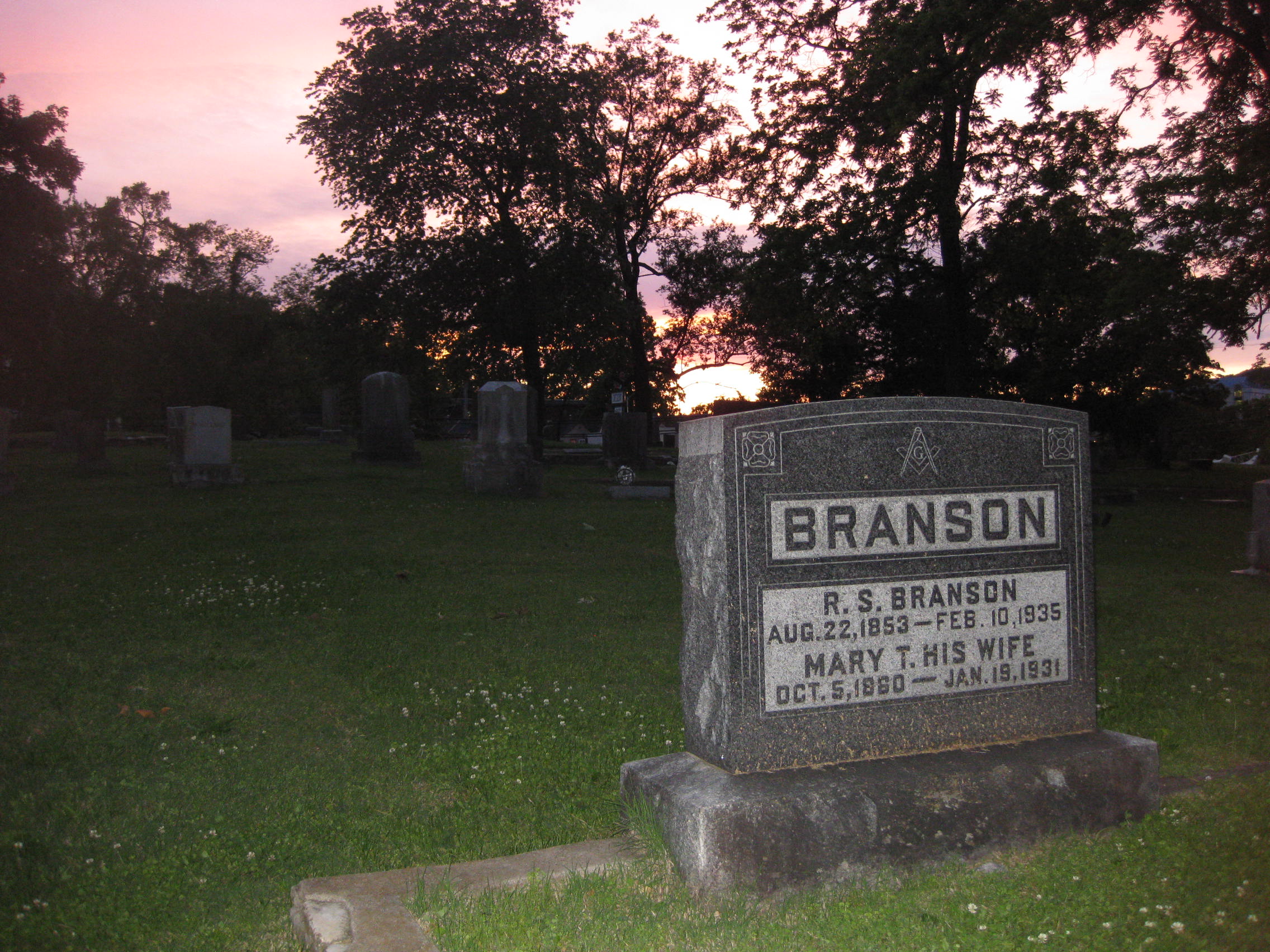
Branson cemetery

Branson cemetery

Rueben Branson, Branson’s first postmaster, and his wife Mary lie here, in this green place in downtown Branson.

Over the past few years, I’ve been photographing the graves of my ancestors in Texas, Oklahoma and Arkansas, trying to imagine the communities where they lived and died and the landscapes they encountered in the 1800s.

If you don’t know where your ancestors were buried, you can often find them on the internet.

Beautiful bridges of the Ozarks

Posted on

Who doesn’t love a bridge? Other than the ferry operator, who lost a job.

Miranda recently commented on this blog that she missed the photo of the Taneycomo bridge between Branson and Hollister that I used to have at the top of this page.

Here’s a larger view of it:
cropped-img_02963.jpg

On Sunday morning, I put my boat in upper Bull Shoals at the River Run ramp at Forsyth, next to the Missouri Highway 76 bridge. Here’s that bridge:
Hwy 76 bridge over Bull Shoals

Just upstream are the two bridges at the mouth of Swan Creek at Shadow Rock Park. A year ago, the lower bridge in the foreground was submerged Read the rest of this entry