Category Archives: Ozarks economy

Thinking of charities?


The tradition of  buying Christmas gifts–involving the decisions to loosen purse strings and use available credit–makes us especially receptive to appeals from those who seek help for needy people. If we feel we must buy gifts for relatives, we can surely put a little something in the red bucket.

And if we want to deduct a contribution on our 2010 tax return, we have to make the gift before the end of December.

What do you think of the following:

Having decided that charitable giving is a worthy cause, the government subsidizes charitable gifts from certain households, and for those chosen to be part of the plan, every dollar donated to a charity is increased by a specified percentage. To qualify, taxpayers must have a substantial home mortgage; the subsidy rate increases with taxable income. Low-income taxpayers receive no subsidy, but donations from qualified high-income taxpayers are subsidized by as much as 40 percent — or more.

This sounds ridiculous. The government gives more back for the same contribution depending on how much income the donor has, shifting the burden of the expense of government from richer to poorer.

But it’s what the federal income tax code already provides, as pointed out in today’s New York Times by Richard Thaler, a University of Chicago economics professor, who explains it pretty well. If you’re in the top tax bracket, a contribution of $1,000 to a charity will lower your income tax by $360. But if you’re in the lowest bracket, the same $1,000 donation will reduce your taxes by $150. Perhaps this bothers only economists. 

Simplifying our income tax system is incredibly difficult, a situation made more complicated because so many of our institutions (such as churches, hospitals, universities and social service organizations) depend on the charitable tax deduction.  As much as we all want tax reform, restriction or elimination of the deduction for charitable contributions–which is a part of every tax reform proposal–will dramatically change the way many institutions and organizations operate, affecting those who benefit from their activities.

Give now. People need help. And if you’re in the top bracket, I don’t mind if you give a lot.

Offshore company loses assets, while hiding from liabilities


It’s great to be hard to find, but sometimes it causes you to lose stuff.

In the case of United Asset Management v. Clark, United lost its real estate in Cass County, Missouri, having failed to pay its taxes. If United hadn’t played hard to find, there’s a good chance that it would have received the notices from the county collector and from Clark, who bought the property at the collector’s sale.

This 40-page opinion of the Western District of the Missouri Court of Appeals adds detail to Missouri’s rapidly growing body of law that interprets the Jones-Munger Act, which is the collection of Missouri statutes that set out the procedure for collection of property taxes by counties through the advertisement and sale of delinquent real estate.

The Jones-Munger Act provides a period for a property owner to redeem property after somebody else has paid the taxes. The United States Constitution’s protection of property owners from confiscation without due process requires strict adherence to statutory procedures to assure that nobody loses their property without notice.

According to this opinion (and the precedents that it cites), when a county collector receives a tax statement that is stamped with “return to sender, undeliverable at this address, unable to forward,” the collector may be required to do more, rather than merely include the property in the collector’s sales, held in Missouri counties on the fourth Monday of each August.

Similarly, when the purchaser of a property at a tax sale applies for a collector’s deed, the purchaser must make a diligent effort to give notice to the property owner and any lienholders (such as those holding a mortgage on the property) that their redemption rights will expire.

Just what is required of the county collector and the tax sale purchaser depends on the circumstances, especially since the Jones v. Flowers decision of 2006, one of the first United Supreme Court opinions written by Chief Justice John Roberts. But Roberts wrote that the return of the envelope triggers a process that must be appropriate under the circumstances. For a tax collector or a purchaser of a tax certificate, it’s usually a good idea to:

  •  send a notice by regular mail, in addition to certified mail
  • send a notice addressed to “occupant”
  • knock on the door or post a notice, if there’s a building on the property
  • look in the phone book or call directory assistance
  • use an internet search engine
  • check property tax records (including vehicle records) for another address for the same party

I’ve been able to persuade courts to set aside collector’s deeds when the purchaser at tax sale couldn’t demonstrate diligence.

But United Asset Management Trust Company was too hard to find, which might be desirable for one wanting to avoid paying taxes and other debts. But United paid a price for being elusive.

United was the trustee for Coast to Coast Holding Company, which had no address in the United States, but was domiciled in Grand Turk, Caicos, British West Indies. Somewhere along the line, its Missouri post office box was cancelled, with no forwarding address. United Trust’s manager was in another state. The Cass County Collector was diligent, but couldn’t locate United, Neither could Clark, who bought the property at the collector’s tax sale. There was no building on the property and nowhere to post a notice.

The appellate court agreed with the trial court. The county collector and the purchaser at the tax sale did all that was reasonable and practical under the circumstances created by United. So United lost its real property for a few dollars in taxes.

Pen-raised whitetail deer are domestic animals, under Missouri law


If a court told me that I had to kill my dog for killing a deer, I’d be upset. But it could happen.

When a dog kills or maims a “domestic animal” in Missouri,  the statutory penalties (section 273.020 RSMo) are harsh. The owner or keeper of the bad dog is liable for the full amount of monetary damages and is obligated to kill the bad dog. But can whitetail deer be considered domestic animals?

Three dogs, alleged to have been owned by Lange, broke into Oak Creek’s pen and killed 21 bucks, does and fawns, all hand-raised and kept for the ultimate purpose of creating bucks with massive racks. When Oak Creek sued Lange, Lange asked the court to rule, in a motion for summary judgment, that the words “sheep and other domestic animals” in section 273.020 applied to livestock typically raised on farms, such as cattle, swine, chickens and horses.

The Missouri court of appeals in Oak Creek Whitetail Ranch v. Lange disagreed with the Osage County trial judge, looking to a dictionary definition, which included the phrase “which have been domesticated by man so as to live and breed in a tame condition.” The court of appeals noted that the slain deer had never been in the wild, but “were all penned and hand-fed, raised in an environment that did not allow them to move freely beyond their confined area.”  The court’s logic is apparently that whether an animal (other than a sheep) is domestic is determined by the individual animal’s status, not the species. Oak Creek’s deer were apparently defenseless in their confinement, unable to flee and perhaps unable to survive in the wild. Cats, dogs and hogs often become feral, regardless of their previous condition of confinement.

The offspring of breeding stock, such as those killed in Oak Creek’s pen, are apparently not domestic animals when placed on game ranches to be killed by trophy-seeking hunters, who pay handsomely for the privilege of slaughtering them. You can see an example of the ideal rack on the Farming for Wildlife website.

My neighbor fenced in my backyard!


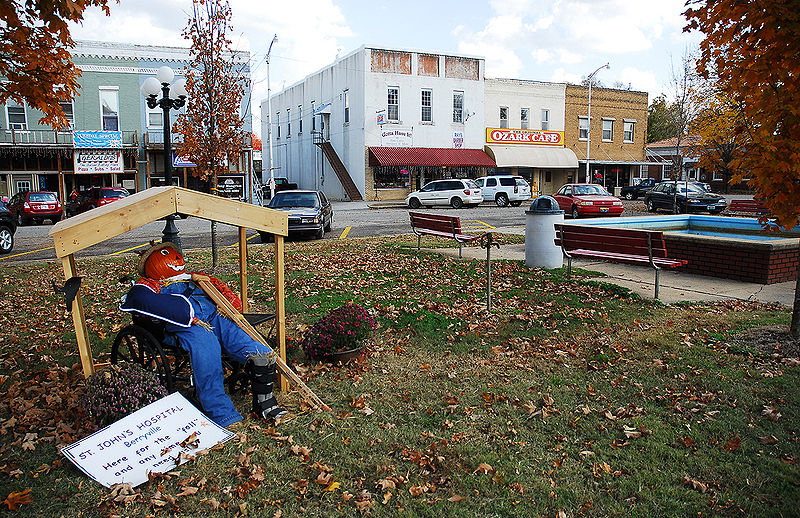
The rear of the Grossmans’ backyard had several trees and a culvert along the property line. When they put up a privacy fence in 1994, they didn’t enclose a nine-foot strip across the rear. The St. Johns moved into the house on the lot that shared the rear line of Grossmans’ lot in 2004, and the St. Johns began to maintain that nine-foot strip along with their own backyard, removing debris and even laying sod.

In 2008, the St. Johns fenced in their backyard and extended their fence across the nine-foot strip to a point five inches from the Grossmans’ fence. The Grossmans’ attorney sent a letter to the St. Johns, asking that they remove their fence and discontinue using the nine-foot strip.

The Grossmans sued the St. Johns for trespass, also asking for an injunction to force the St. Johns to remove the portion of the St. Johns’ fence on the Grossmans’ property. The St. Johns countersued, seeking reimbursement for their maintenance and repairs of the nine-foot strip.

Trespass under Missouri law, in a civil case, requires the plaintiff to prove unauthorized entry onto the property of another, regardless of damages and regardless of good faith, reasonable care, ignorance or mistake of law or fact.  Missouri law also allows the defense of consent of the complaining property owner, whose consent may be implied by custom, usage or conduct. Proof of damages resulting from the trespass is not required, but monetary damages can be recovered if proved.

At the trial, Mr. Grossman testified that he was aware that the St. Johns installed solar lights, plants and concrete benches on the nine-foot strip and admitted that it didn’t bother him. The St. Johns argued that this admission was proof of implied consent.

The trial court found for the St. Johns on the trespass charge, apparently accepting the argument of implied consent. The trial court also rejected the St. Johns’ counterclaim for reimbursement of their costs of repairs and maintenance. The Grossmans appealed; the St. Johns did not.

The Western District of the Missouri Court of Appeals in Grossman v. St. John reverses the trial court, stating that the judgment in favor of the St. Johns on the injunction and trespass claims was “against the weight of the evidence and was erroneous.”

In other words, there was inadequate evidence in the record of the trial to show that the Grossmans had consented to the erection of the fence, even though they may have initially consented to the use of the nine-foot strip by the St. Johns. That consent was revoked by the letter from Grossmans’ lawyer. By ignoring the undisputed revocation of consent, the judge made an error.

Please note that the use of Grossmans’ property by the St. Johns only lasted for four years. Had the use continued for 10 years, the St. Johns would not have been arguing consent–they would state that they used the property openly and without consent, thereby entitling them to title by adverse possession. The Grossmans’ suit was necessary to protect their property from such a claim.

Season of smoke


The crisp air of this dry autumn is in sharp contrast to the smoke blown at us by those who are telling us how to vote.

The political rhetoric–coming from all parties (including the Tea Party) and independents and those groups funded anonymously–is simply insulting.

Yesterday, away from political signs, I enjoyed an outing on the Glade Top Trail, near the Taney County-Ozark County border in the Mark Twain National Forest. The sunlight coming through the leaves made me think of this poem, “Pied Beauty,” by Gerard Manley Hopkins:

Glory be to God for dappled things–
For skies of couple-colour as a brinded cow;
For rose-moles all in stipple upon trout that swim;
Fresh firecoal chestnut falls; finches’ wings;
Landscape plotted and pieced–fold, fallow, and plough;
And all trades, their gear and tackle and trim.

All things counter, original, spare, strange;
Whatever is fickle, freckled (who knows how?)
With swift, slow; sweet, sour; adazzle, dim;
He fathers forth whose beauty is past change:
Praise him.

Unlike the poet Hopkins, I took joy in seeing a landscape that had not been plotted and pieced and plowed. But I’m with Hopkins in enjoying the beauty of dappled things, the fickle and freckled, and the contrasts of swift and slow, sweet and sour, dazzling and dim.

Judge corrected for merging both Carroll County judicial districts


Eureka Springs and Berryville, both towns in Carroll County, Arkansas, are just eight miles apart, separated by the valley of the Kings River. The Arkansas legislature in 1883 created a judicial district for the county west of the Kings River and the another judicial district on the east side of the river.

But in 2010, for reasons not explained in the Arkansas Supreme Court’s opinion, Parker v. Crow, Eastern District Judge Gerald Crow ruled that henceforth there would be only one judicial district in Carroll County.

Eureka Springs, west of the Kings River, is a tourist town and art colony, known for its Victorian architecture, with bathhouses, galleries and restaurants in a setting of steep hills and narrow streets, all maintained with strict building controls.
Berryville sits on a stretch of prairie east of the Kings River, surrounding by rolling hills and cattle and poultry farms. A Tysons poultry processing plant and a Walmart Supercenter are among the town’s largest employers.

In 1869, as northern Arkansas began to recover from the ravages of the Civil War, Boone County was created from the eastern portion of Carroll County, with Harrison as the county seat. Carrollton, a settlement 20 miles southeast of Berryville, was no longer at the center of Carroll County, and Berryville’s boosters succeeded in having the county seat established in Berryville in 1875.

In 1883, the Eureka Springs Railway was extended south from Missouri, and Eureka Springs quickly blossomed into a small city of hotels (quaint and magnificent) and bathhouses, fed by the waters of dozens of springs. The same year, the Arkansas General Assembly passed Act 74, creating two judicial districts for Carroll County.

Judge Crow’s bold attempt to merge the two districts probably left the Arkansas Supreme Court dumbfounded, but the opinion restoring the two districts simply cites some basic principles of American government to indicate the degree that Judge Crow’s opinion was off-base.

Judge Crow’s first contention was that the 1883 act of the legislature creating the two districts was unconstitutional because it attempted to create a new county, even though the language of the statute specified that the districts were to keep separate records as though they were in different counties, but that Carroll County should in all other respects “be one entire and undivided county.”

Judge Crow also determined that at 1997 legislative act, among other laws, repealed the 1883 act by implication. The Arkansas Supreme Court recited the rule that repeal by implication “is never allowed except where there is such an invincible repugnancy” that the old and new laws “cannot both stand together.” The 1997 law, and the others, may be messy and partially inconsistent, but they did not specifically repeal the 1883 act.

Almost as an afterthought, the Arkansas Supreme Court examined the Arkansas constitution, noting that the power to establish or dissolve judicial districts was a legislative power, not something that a judge could do.  Quashing Judge Crow’s attempt to merge the two judicial districts, the Supreme Court said that his order “shows a plain, manifest, clear and gross abuse of discretion.”

When you sue, you’d better ask for everything


Johnny Ray Chadd was the city administrator for Lake Ozark. City administrators in Missouri are always a vote or two away from getting fired, and Chadd was on the brink. On a vote to fire him in 2005, after he had served less than one year, the aldermen were deadlocked and the mayor cast the tie-breaking vote to let him go.

Chadd sued, claiming that the applicable Missouri statute and the city ordinance required the vote of a majority of the aldermen to remove him as a city officer. The mayor’s vote was irrelevant. In 2007, the appellate court ordered that Chadd be reinstated. He was rehired and immediately fired by the unanimous vote of the aldermen.

Chadd sued again, seeking back wages for the period between his first firing and the second, also alleging that he was wrongfully terminated. Apparently because Missouri law characterizes the employment relationship as at the will of the employer, Chadd alleged that his termination fell under the vague term “prima facie tort,” a legal theory that has never gotten any traction in Missouri courts.

The trial court threw out Chadd’s suit on Lake Ozark’s motion for summary judgment.

Chadd didn’t sue for back wages in the first suit, so he was barred from bringing up the issue now under the principle of res judicata. This principle means that courts will not consider claims that either were or could have been raised in a previous suit between the same parties. The trial court indicated that Chadd had been obligated make his claim for back wages in his first suit, where he was successful.

The prima facie tort claim also failed. Missouri’s at-will employment doctrine applies to situations where there is no employment contract for a specific term. A worker cannot win a suit for damages resulting from termination unless the termination violates some other statute, such as a statute protecting whistle-blowers or persons who are fired for filing workers’ compensation or racial discrimination claims, for example.  Calling a wrongful termination claim a prima facie tort doesn’t get around the at-will employment doctrine.

The Court of Appeals upheld the summary judgment in this opinion, Chadd v. Lake Ozark.

Partition: not always an equal division of real estate


No house is big enough for two couples, my mother told me long ago. Especially when one couple pays for nearly everything.

When the non-paying couple asked the court to divide the house, a Missouri court left them out in the cold. They appealed, and the court’s decision in Hoit v. Rankin indicates Read the rest of this entry

“Years of combined experience” : how does it add up?


My wife and I have been married 36 years. I suppose you could say that we have 72 years of combined experience being married. Does that mean that I should be a marriage consultant?

Judging from the use of “years of combined experience” in advertisements, many people must think that combined experience adds up to expertise, even in the Show-Me State, where people are not sheeple but skeptics. Here are some samples: Read the rest of this entry

Getting outside in the Ozarks


Within a week, the heat wave will have run its course and we’ll surely have a little rain. Then we can get moving again in the wonderful Ozarks outdoors and watch the greens become gold, orange and red.

Here are some links for outdoor activities Read the rest of this entry