Category Archives: Missouri law

When you sue, you’d better ask for everything


Johnny Ray Chadd was the city administrator for Lake Ozark. City administrators in Missouri are always a vote or two away from getting fired, and Chadd was on the brink. On a vote to fire him in 2005, after he had served less than one year, the aldermen were deadlocked and the mayor cast the tie-breaking vote to let him go.

Chadd sued, claiming that the applicable Missouri statute and the city ordinance required the vote of a majority of the aldermen to remove him as a city officer. The mayor’s vote was irrelevant. In 2007, the appellate court ordered that Chadd be reinstated. He was rehired and immediately fired by the unanimous vote of the aldermen.

Chadd sued again, seeking back wages for the period between his first firing and the second, also alleging that he was wrongfully terminated. Apparently because Missouri law characterizes the employment relationship as at the will of the employer, Chadd alleged that his termination fell under the vague term “prima facie tort,” a legal theory that has never gotten any traction in Missouri courts.

The trial court threw out Chadd’s suit on Lake Ozark’s motion for summary judgment.

Chadd didn’t sue for back wages in the first suit, so he was barred from bringing up the issue now under the principle of res judicata. This principle means that courts will not consider claims that either were or could have been raised in a previous suit between the same parties. The trial court indicated that Chadd had been obligated make his claim for back wages in his first suit, where he was successful.

The prima facie tort claim also failed. Missouri’s at-will employment doctrine applies to situations where there is no employment contract for a specific term. A worker cannot win a suit for damages resulting from termination unless the termination violates some other statute, such as a statute protecting whistle-blowers or persons who are fired for filing workers’ compensation or racial discrimination claims, for example.  Calling a wrongful termination claim a prima facie tort doesn’t get around the at-will employment doctrine.

The Court of Appeals upheld the summary judgment in this opinion, Chadd v. Lake Ozark.
Partition: not always an equal division of real estate


No house is big enough for two couples, my mother told me long ago. Especially when one couple pays for nearly everything.

When the non-paying couple asked the court to divide the house, a Missouri court left them out in the cold. They appealed, and the court’s decision in Hoit v. Rankin indicates Read the rest of this entry

It’s about time and about money: Missouri’s Sentencing Advisory Commission’s cost analysis


While I have staked out the territory of Ozarks law and economy for this blog, I’m humbled that the New York Times is doing a great job of researching and writing stories on my turf. The quality of the reporting is superb; those whose opinion of the Times is based on aversions to the biases of its op-ed writers (David Brooks, Gail Collins, Maureen Dowd, Paul Krugman, Tom Friedman and Nicholas Kristof) will find the news stories about Missouri to be evenhanded and well-sourced.

Ten days ago, the Times reported on Missouri’s public defenders refusing to take more cases, a situation that came to a head in Christian County, Missouri, across the street from my office in Ozark.

Today, the Times reported on the Missouri Sentencing Advisory Commission’s provision of cost information to judges, so that judges can  Read the rest of this entry

Purchase option is assignable without consent, but there can still be a fight


The Hulls signed a real estate lease with a purchase option and put down a deposit of $56,000, which could be applied to the $198,500 purchase price, but would otherwise be non-refundable. The Hulls created a limited liability company (LLC) called Briar Road, and Briar Road attempted to exercise the purchase option. Stenger, the seller, refused, claiming that it had not approved the assignment of the purchase option by the Hulls to Briar Road.

What difference does the identity of the purchaser make? Read the rest of this entry

Is it necessary to affirm the right to hunt and fish in state constitutions?


“I liked it better when I was hunting birds there,” said the mediator, when he figured out the location of the garages at a Branson condominium. Seven attorneys gathered to attempt to resolve a dispute over rights to use four garages at the condominium.

As the Ozarks and much of rural America becomes suburbanized, many people want to protect their cherished traditions of hunting and fishing. In ten states, citizens have amended their constitutions to affirm the right to hunt and fish. Oklahoma has done so and the proposal is being considered in Arkansas and Tennessee.

As I hear people in the Ozarks express themselves about land and water and fish and game, I hear the same arguments that have been made to affirm the rights of native peoples to continue their hunting and fishing traditions, some of which have been protected from state regulation by federal law.

The Ozarks have been populated by people of mostly European ancestry for nearly 300 years. After many generations, it’s no wonder that members of old Ozarks familes feel like they need to assert themselves to hang on to their culture. And those whose families haven’t been around as long would naturally want to feel secure in their adopted traditions.

Missouri’s weak commitment to criminal defendants: is there a solution?


The glum face of associate circuit judge John Waters graces the pages of the New York Times, along with photos of Jared Blacksher, who sits in the Christian County jail, awaiting a court-appointed attorney to defend him.

Judge Waters, whose chambers are in the Christian County courthouse in Ozark, Missouri, ten miles south of Springfield, ordered the public defender to represent Blacksher, but the public defender Read the rest of this entry

Whoops. Missouri Supreme Court releases man convicted in 1993 without jurisdiction.


The Missouri Supreme Court today ordered the release of Dwight Laughlin, who was convicted in 1993 of burglary and property damage crimes at the post office in Neosho, Missouri in State ex rel Laughlin v. Bowersox. You can read the briefs here.

At Laughlin’s trial in 1993, his attorney failed to Read the rest of this entry

Summary judgment reversed, no surprise, but in a collection case?


Baca, a chiropractor, sued the Cobbs for fees. The Cobbs answered that at least part of the fees were unreasonable, alleging that Baca jacked Read the rest of this entry

Horse on the highway! Who is liable?


Barker’s horse bolted through an open gate on Matchett’s farm and ran onto the highway. A car hit the horse, then careened into Gromer’s car, injuring Gromer, who filed a lawsuit in Butler County, Missouri.

Gromer settled with the other driver and Barker before the trial. Then Gromer convinced a jury that Matchett should be at least partly responsible. He owned the farm with the open gate where Barker boarded his horse.

Missouri’s Stock Law, section 270.101 RSMo, makes a person whose livestock gets onto a highway responsible for Read the rest of this entry

Who owns abandoned public roads in Missouri?


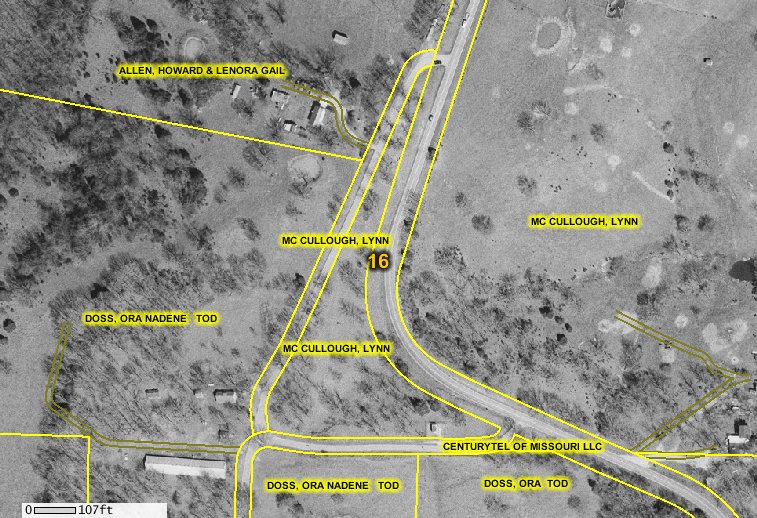
As Missouri’s public roads have been straightened, many odd kinks of roadway are left over, along with triangles of land between the old roads and the new roads. As we drive, we see these pieces of the old roads, sometimes serving as frontage roads along divided highways. In some cases, such as in McCullough v. Doss and Allen, the triangle on the west side of the new road was sold to McCullough, even though they might have been able to claim that at least the west half of the abandoned right-of-way of the old public road was theirs. Here’s an image from the Stone County Assessor’s maps:

The State of Missouri built Highway 39 in the mid-1950s, mainly along an old public road. At the point shown in the image, the severe dogleg Read the rest of this entry