Category Archives: Ozarks

Missouri PSC asserts jurisdiction over one tiny utility company, but many others escape


Water and sewer services to residences and businesses are essential. Most of us take for granted that the operations of those who provide these services are reliable and are regulated. In reality, many water and sewer providers fall through several holes in Missouri’s statutory framework of regulation by the Missouri Department of Natural Resources (DNR) and the Missouri Public Service Commission (PSC).

DNR’s regulations

DNR sets engineering standards for water wells, treatment and storage facilities, and distribution systems (mains and valves). DNR licenses well drillers and maintains a registry describing each water well, based on data required to be submitted by well drillers. DNR does not regulate rates charged by water sellers, but does require that permanent entity (called a “continuing authority”) be established for each water system serving more than 15 users. A continuing authority for water is required to show DNR that it has the technical, managerial and financial capacity to operate the system, or at least that’s what the rules say. DNR implements its regulations by requiring submittal of engineering plans for the issuance of construction permits and certfications from private engineers that water and sewer facilities are completed according to the approved plans before issuance of operating and discharge permits. DNR also licenses operators of water and sewer facilities. Read the rest of this entry

Fathers of my understanding of the Ozarks


Someone looking at my life could correctly observe that my life’s work has consisted of absorbing all I can about the history, economy and people of the Ozarks. I began this undertaking as a youngster at the Newton County Library in Neosho in about 1960, probably with a book by Vance Randolph or the Chapmans’ Indians and Archaeology of Missouri.

Much of what I have learned about life in the Ozarks has come from living and working in the Ozarks. But what I’ve learned from books and scholars has given me a mental framework for organizing what I have learned and helps me to be a better observer. Read the rest of this entry

Table Rock Lake and the cost of economic activity

Posted on

Kathleen O’Dell’s article about the economic impact of Table Rock Lake in today’s Springfield News-Leader, entitled “Table Rock Dam Gives Much Back to Area,” covers a lot of ground in describing the various kinds of economic activities that are related to the construction and continued existence of Table Rock Lake.

In an economic sense, is the Table Rock Lake area fit (efficient and nimble) or obese (expensive to maintain and subject to falls)? As pointed out below, the two counties most affected by Table Rock Lake have experienced the area’s lowest growth in Read the rest of this entry

Decorating and undecorating graves

Posted on

Objects on a tombstone

The weather was rainy in much of the Ozarks today, so I was glad that I had visited cemeteries of mine and my wife’s ancestors on Friday and Sunday.

Pam’s comment to my previous post mentioned the custom of leaving small stones on a tombstone to indicate that a visit was made. I have not seen this, but I saw the arrangement above on a tombstone at Snowdenville Cemetery in eastern Madison County, Missouri, which could have been the work of a groundskeeper who picked up things ahead of the mowers, or it could have been a loving tribute.

When I was sixteen or seventeen, I was hired to mow the Newtonia IOOF Cemetery in Newton County, Missouri. Removing the artificial flowers and the containers of real and artificial flowers, with lots of wire and accessories, was a tedious job, especially for a self-important teenager. In preparing the cemetery for Memorial Day, my mower frequently hit those items as I plowed through the thick spring grass, leaving me to pick up the shredded plaster and plastic pots and unwind the wires from my mower blade.

Many of those paid and unpaid people who maintain cemeteries would be able to do their work more safely and easily if those who leave items would make another visit to pick up those items. These items are decorative for only a few days.

Take a trip to the past on Memorial Day

Posted on

Forsyth Cemetery

Forsyth Cemetery

Cemeteries, for me, offer a place of quiet contemplation. Sometimes, I know just enough of the people buried there to set my imagination running about lives, times and places.

This cemetery in Forsyth holds the remains of Nathaniel Kinney, who led a vigilante group, the Bald Knobbers, for five years before losing his life to vengeance. It also holds the remains of John Hilsabeck, who operated a hotel on the White River at the mouth of Swan Creek in the old Forsyth townsite. At this cemetery, in 1892, John Wesley Bright was hung after having been pulled out of the Taney County jail where he was held for the killing of his young wife.

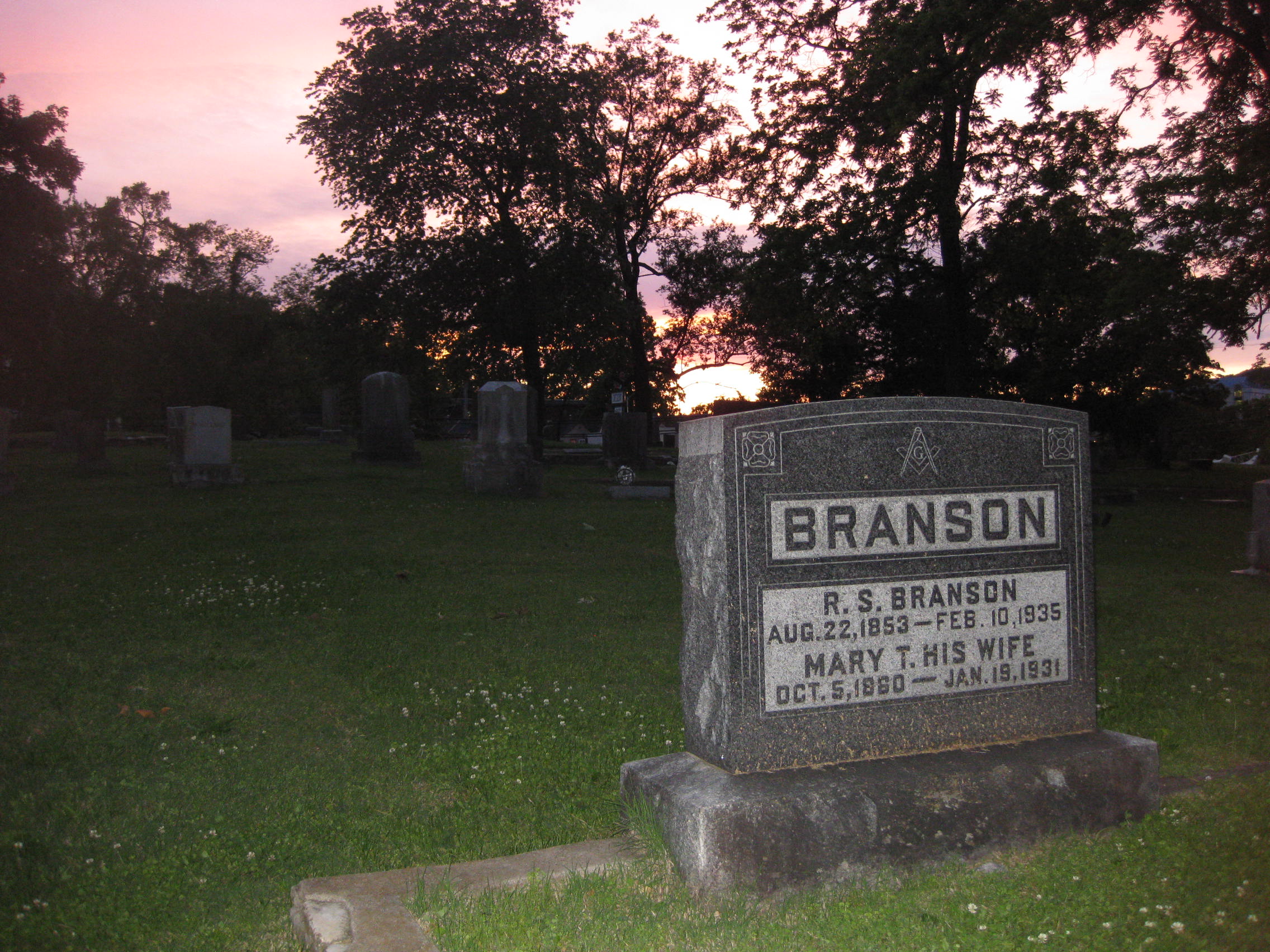
Branson cemetery

Branson cemetery

Rueben Branson, Branson’s first postmaster, and his wife Mary lie here, in this green place in downtown Branson.

Over the past few years, I’ve been photographing the graves of my ancestors in Texas, Oklahoma and Arkansas, trying to imagine the communities where they lived and died and the landscapes they encountered in the 1800s.

If you don’t know where your ancestors were buried, you can often find them on the internet.

Beautiful bridges of the Ozarks

Posted on

Who doesn’t love a bridge? Other than the ferry operator, who lost a job.

Miranda recently commented on this blog that she missed the photo of the Taneycomo bridge between Branson and Hollister that I used to have at the top of this page.

Here’s a larger view of it:
cropped-img_02963.jpg

On Sunday morning, I put my boat in upper Bull Shoals at the River Run ramp at Forsyth, next to the Missouri Highway 76 bridge. Here’s that bridge:
Hwy 76 bridge over Bull Shoals

Just upstream are the two bridges at the mouth of Swan Creek at Shadow Rock Park. A year ago, the lower bridge in the foreground was submerged Read the rest of this entry

Private dam not grandfathered from safety regs

Posted on

Because the possibility that a dam could break is a continuing risk, an old dam isn’t exempt from newer rules for dam safety. So said the Missouri Supreme Court in an opinion released on May 5, 2009, reversing the ruling of a Springfield trial judge.

The trial judge threw out a suit filed by the Missouri Attorney General against the Olives, who had purchased a farm with an old dam on it. The suit alleged that the Olives violated the Missouri dam and reservoir safety law by failing to register the dam with the Missouri Dam and Reservoir Safety Council, a state agency. The dam was built in 1974, five years before the dam and reservoir safety regulations went into effect.

Registration of a dam triggers the implementation of a safety program and requires the submittal of an as-built survey of the dam. In other words, registration is the beginning of a process that allows the Dam and Reservoir Safety Council to keep track of the dam, make requirements for maintenance and repairs, and review any proposals for modification of the dam.

The trial judge’s decision was based on two points Read the rest of this entry

Get outside


Indian paintbrush at Baker Prairie, Harrison, Arkansas

Indian paintbrush at Baker Prairie, Harrison, Arkansas

I’ve have links here (see sidebar) to a category called Ozarks Nature. The sites listed here are the work of talented people, whose writing and photography are of unusually high quality. I’m not a scientist, but these people open a welcoming door to that world, so that my enjoyment of being outside is richer.

Of the four, I have met only Jim Long, but I hope to meet the other writers someday.

When you click a link in this article or on the sidebar, it will open in a new window, so that you can use your browser’s “back” button or arrow to get back here to go to the next site.

Beetles in the Bush belongs to Ted MacRae, a St. Louis scientist who studies bugs. His photography and commentary are wonderful. Even if bugs bother you, this site should teach you some fascinating things to think about before you swat, stomp or spray.

Allison Vaughn’s The Ozark Highlands of Missouri, is the work of a working naturalist, who apparently lives in  central Missouri and works for a state agency. Her passion for setting fires in connection with controlled burning of woods and savannas spices up her writing.

Jo Schaper’s Missouri World examines the Ozarks from the point of view of a geologist with knack for journalism. Jo works with my brother Emery’s print and online outdoor monthly River Hills Traveler as a writer and copy editor.

Jim Long, as I’ve mentioned here, is a nationally-known gardener and teacher, whose herb farm is near the Arkansas-Missouri border near Blue Eye. He travels the country lecturing about growing flowers, vegetables and herbs, and promotes the enjoyment of wholesome garden products. His website Jim Long’s Garden is a treasure of tips for the garden and the table.

All these sites can pull you in for a while, but you shouldn’t let them keep you from enjoying the Ozarks in springtime.

It’s time to enjoy Ozarks creeks, legally


Many canoeists, like these, are ignorant of Missouri law, and couldn't care less.

Many canoeists, like these two, are ignorant of Missouri law and couldn't care less.

Much of the fun in the creeks of the Ozarks is good, clean fun. But it’s not always legal.

Figuring out what is a legal use or behavior with regard to creeks and streams isn’t always easy, because several different federal and state agencies administer a confusing and overlapping bunch of rules. And what folks think they know that just ain’t so would fill a lake.

I’ve added a permanent page here called “Missouri water law primer: streams”  which I hope will help. Please comment to let me know if you know of something that I might add or clarify. I’m also planning to  add other pieces relating to water wells and groundwater and lakes and boat docks.

My brother Emery Styron publishes, online and in print, a monthly newsmagazine, River Hills Traveler, and Guides and Outfitters, which is a statewide (for Missouri) directory of canoe outfitters, campgrounds, hunting and fishing guides, etc., with links to river and lake levels, and other useful and interesting information.

Missouri Supreme Court disses certified mail notice


A unanimous opinion of the Missouri Supreme Court, dated March 31, 2009, holds that section 140.405 of the Missouri Revised Statutes is unconstitutional.

This statute provides for notice by certified mail to delinquent property taxpayers that someone has paid the taxes on their real estate and that they must redeem their property by paying the taxes, or lose it. If the certified mail notice is unclaimed, the person giving the notice (who is the purchaser of a tax certificate at a sale of delinquent property), that person must take additional steps to notify the delinquent taxpayer that a collector’s deed will be issued to the person who purchased the tax certificate. Read the rest of this entry